By the end of this module, learners will be able to:
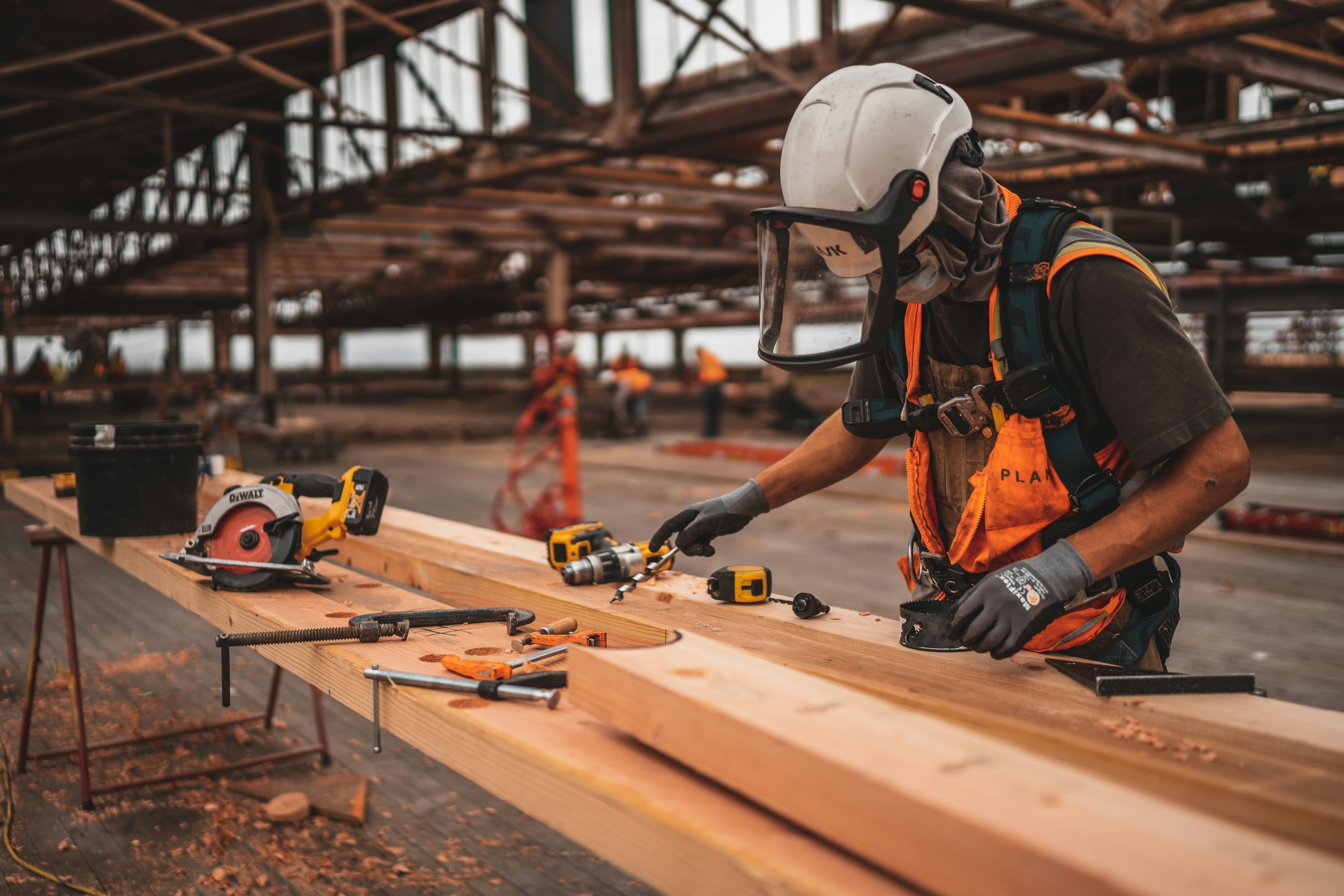
Nail guns are powerful, easy to operate, and boost productivity for nailing tasks. They are also responsible for an estimated 37,000 emergency room visits each year. Severe nail gun injuries have led to construction worker deaths.
Nail gun injuries are common in residential construction. About two-thirds of these injuries occur in framing and sheathing work. Injuries also often occur in roofing and exterior siding and finishing.
How likely are nail gun injuries? A study of apprentice carpenters found that:
More than half of reported nail gun injuries are to the hand and fingers. One-quarter of these hand injuries involve structural damage to tendons, joints, nerves, and bones. After hands, the next most often injured are the leg, knee, thigh, foot, and toes. Less common are injuries to the forearm or wrist, head and neck, and trunk. Serious nail gun injuries to the spinal cord, head, neck, eye, internal organs, and bones have been reported. Injuries have resulted in paralysis, blindness, brain damage, bone fractures, and death.
Nail guns present a number of hazards and risks. NIOSH and OSHA prepared this publication to provide builders and contractors with the latest information on nail gun hazards and practical advice on the steps they should take to prevent nail gun injuries on their construction jobs.
A 26-year-old Idaho construction worker died following a nail gun accident in April 2007. He was framing a house when he slipped and fell. His finger was on the contact trigger of the nail gun he was using. The nosepiece hit his head as he fell, driving a 3-inch nail into his skull. The nail injured his brain stem, causing his death. The safety controls on the nail gun were found to be intact. Death and serious injury can occur using nail guns —even when they are working properly.
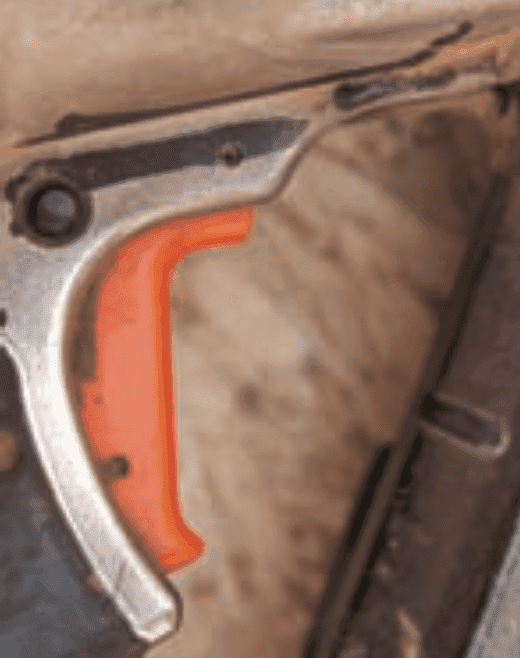
Trigger
This guide covers nail guns (also called nailers) used for fastening wood, shingles, and siding materials. The guide refers specifically to pneumatic tools but also applies to nail guns that use gas, electric, or hybrid power sources. It does NOT cover powder actuated tools used for fastening material to metal or concrete. The guide assumes that contractors are generally familiar with how nail guns work and the various types of specialized nail guns (for example, framing, roofing, flooring).
This guide is applicable to all nail guns. The emphasis is on framing (“stick” and “coil”) nail guns because they fire the largest nails, are the most powerful, and are considered to be the most dangerous to use.
Nail gun safety starts with understanding the various trigger mechanisms. Here is what you need to know:
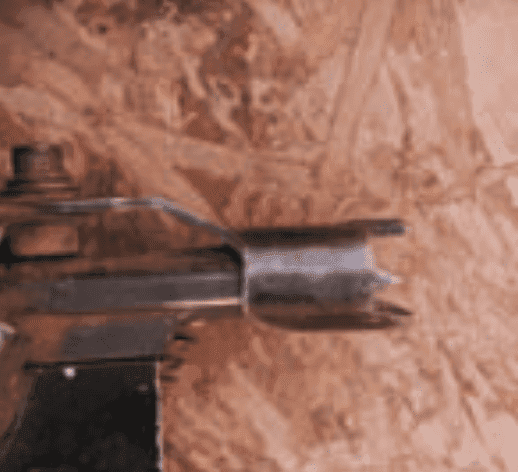
Contact Safety Tip
All nailers rely on two basic controls: a finger trigger and a contact safety tip located on the nose of the gun. Trigger mechanisms can vary based on:
Combining these variations gives four kinds of triggers. Some nail guns have a selective trigger switch which allows the user to choose among two or more trigger systems.
Each trigger type is described below along with a summary of how the controls are activated.
Question
What are the two basic controls that all nailers rely on?
Answer the question above the continue reading. iTELL evaluation is based on AI and may not always be accurate.
This is the safest type of nail gun trigger. This trigger will only fire a nail when the controls are activated in a certain order. First, the safety contact tip must be pushed into the work piece, then the user squeezes the trigger to discharge a nail. Both the safety contact tip and the trigger must be released and activated again to fire a second nail. Nails cannot be bump fired. Also known as single- shot trigger, restrictive trigger, or trigger fire mode.
Single nail:
Push safety contact, then squeeze trigger
Multiple nails:
Release both safety contact and trigger and repeat process
Question
What is the process for firing a single nail with this type of trigger?
Answer the question above the continue reading. iTELL evaluation is based on AI and may not always be accurate.
Fires a nail when the safety contact and trigger are activated in any order. You can push the safety contact tip first and then squeeze the trigger, or you can squeeze the trigger first and then push the safety contact tip. If the trigger is kept squeezed, a nail will be driven each time the safety contact is pushed in.
All nails can be bump fired. Also known as bump trigger, multi-shot trigger, successive trigger, dual-action, touch trip, contact trip, and bottom fire.
Single nail:
Push safety contact, then squeeze trigger, or squeeze trigger, then push safety contact
Multiple nails:
Squeeze and hold trigger, then push safety contact to fire one nail, move and push safety contact again to fire additional nails
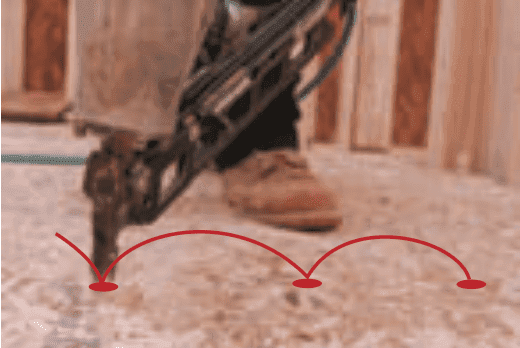
Bump firing or bounce nailing is using a nail gun with a contact trigger held squeezed and bumping or bouncing the tool along the work piece to fire nails. Red dots show path of motion.
Like the full sequential trigger, this trigger will only fire a nail when the controls are activated in a certain order. First, the safety contact tip must be pushed into the work piece. Then, the user squeezes the trigger to discharge a nail. To fire a second nail, only the trigger must be released. The safety contact tip can stay pressed into the work piece. Nails cannot be bump fired.
Single nail:
Push safety contact, then squeeze trigger
Multiple nails:
Release trigger, move tool, and squeeze trigger to fire additional nail
Question
How can a second nail be fired using this trigger?
Answer the question above the continue reading. iTELL evaluation is based on AI and may not always be accurate.
Like the contact trigger, this trigger will fire a single nail when the safety contact and trigger are activated in any order. A second nail can be fired by releasing the trigger, moving the tool and squeezing the trigger again without releasing the safety contact tip. Note that some manufacturers refer to these triggers as “single sequential triggers”, but they are different. The first nail can be bump fired with a single actuation trigger but not with a true single sequential trigger.
Single nail:
Push safety contact, squeeze trigger, or squeeze trigger, then push safety contact to fire
Multiple nails:
Release trigger, move tool, and squeeze trigger to fire additional nail
Question
How can a second nail be fired with the trigger described in the passage?
Answer the question above the continue reading. iTELL evaluation is based on AI and may not always be accurate.
The International Staple, Nail and Tool Association (ISANTA) voluntary standard includes technical definitions for trigger “actuation systems”. Tool manufacturers have names for trigger modes such as “intermittent operation method” or “precision placement driving”. Contractors and workers use their own names for triggers and operating modes such as “single shot” and “multi-shot”.
The bottom line: contractors should check the tool label and manual for manufacturer‑specific trigger names and operating information.
Question
What should contractors check for regarding trigger modes when using tools?
Answer the question above the continue reading. iTELL evaluation is based on AI and may not always be accurate.
Recoil is the rapid rebound or kick-back after the nailer is fired.
A double fire occurs when a second nail unintentionally fires because the nailer re-contacted the work piece after recoil. It can also occur if the safety contact slips while the user is positioning the nail gun. Several tool manufacturers offer “anti-double fire” features for their nail guns.
Unintended nail discharge is a common source of injuries. A study of workers’ compensation records found that two-thirds of nail gun injury claims involved some type of unintended nail gun discharge or misfire.
Two framers were working together to lay down and nail a subfloor. One framer was waiting and holding the nail gun with his finger on the contact trigger. The other framer was walking backwards toward him and dragging a sheet of plywood. The framer handling the plywood backed into the tip of the nail gun and was shot in the back. The nail nicked his kidney, but fortunately he recovered. As a result of this incident, the contractor switched to using only sequential triggers on framing nail guns. Co-workers can get injured if they bump into your contact trigger nail gun. You can prevent this by using a full sequential trigger.

Unintended nail discharge is a common source of injuries. A study of workers’ compensation records found that two-thirds of nail gun injury claims involved some type of unintended nail gun discharge or misfire. There are seven major risk factors that can lead to a nail gun injury. Under- standing them will help you to prevent injuries on your job sites.
Question
What percentage of nail gun injury claims involve unintended nail gun discharge or misfire?
Answer the question above the continue reading. iTELL evaluation is based on AI and may not always be accurate.
Occurs with CONTACT triggers.
The Consumer Product Safety Commission (CPSC) found that contact trigger nailers are susceptible to double firing, especially when trying to accurately place the nailer against the work piece.5 They found that a second unintended firing can happen faster than the user is able to react and release the trigger. Unintended nails can cause injuries.
Double fire can be a particular problem for new workers who may push hard on the tool to compensate for recoil. It can also occur when the user is working in an awkward position, such as in tight spaces where the gun doesn’t have enough space to recoil. The recoil of the gun itself can even cause a non-nail injury in tight spaces if the nail gun hits the user’s head or face.
Question
What is a common issue with contact trigger nailers according to the CPSC?
Answer the question above the continue reading. iTELL evaluation is based on AI and may not always be accurate.

Common nail gun grip with finger on trigger
Occurs with CONTACT and SINGLE ACTUATION triggers.
Nail guns with contact and single actuation triggers will fire if the trigger is being held squeezed and the safety contact tip gets knocked or pushed into an object or person by mistake. For example, a framer might knock his leg going down a ladder or bump into a co-worker passing through a doorway. Contact trigger nailers can release multiple nails and single actuation trigger nailers can release a single nail to cause injury.
Holding or carrying contact trigger or single actuation trigger nail guns with the trigger squeezed increases the risk of unintended nail discharge. Construction workers tend to keep a finger on the trigger because it is more natural to hold and carry an 8-pound nail gun using a full, four-finger grip. Tool manufacturers, however, do warn against it.

Nail penetration through the lumber is a special concern where the piece is held in place by hand
Occurs with ALL trigger types.
Nails can pass through a work piece and either hit the worker’s hand or fly off as a projectile (airborne) nail. A blow-out nail is one example. Blow-outs can occur when a nail is placed near a knot in the wood. Knots involve a change in wood grain, which creates both weak spots and hard spots that can make the nail change direction and exit the work piece. Nail penetration is especially a concern for placement work where a piece of lumber needs to be held in place by hand. If the nail misses or breaks through the lumber it can injure the non-dominant hand holding it.
Question
What is one example of nail penetration hazards discussed in the passage?
Answer the question above the continue reading. iTELL evaluation is based on AI and may not always be accurate.
Occurs with ALL trigger types.
When a nail hits a hard surface, it has to change direction and it can bounce off the surface, becoming a projectile. Wood knots and metal framing hardware are common causes of ricochets. Problems have also been noted with ricochets when nailing into dense laminated beams. Ricochet nails can strike the worker or a co-worker to cause an injury.
Occurs with ALL trigger types.
Injuries may occur when the tip of the nail gun does not make full contact with the work piece and the discharged nail becomes airborne. This can occur when nailing near the edge of a work piece, such as a plate. Positioning the safety contact is more difficult in these situations and sometimes the fired nail completely misses the lumber. Injuries have also occurred when a nail shot through plywood or oriented strand board sheeting missed a stud and became airborne.
Question
What can cause injuries when using a nail gun?
Answer the question above the continue reading. iTELL evaluation is based on AI and may not always be accurate.
Toe -nailing
Occurs with ALL trigger types.
Unintended discharges are a concern in awkward position work with CONTACT and SINGLE ACTUATION triggers.
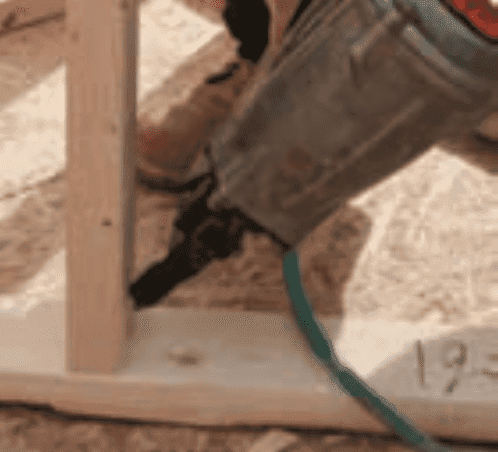
Nailing in awkward positions where the tool and its recoil are more difficult to control may increase the risk of injury. These include toe-nailing, nailing above shoulder height, nailing in tight quarters, holding the nail gun with the non-dominant hand, nailing while on a ladder, or nailing when the user’s body is in the line of fire (nailing towards yourself). Toe-nailing is awkward because the gun cannot be held flush against the work piece. Nailing from a ladder makes it difficult to position the nail gun accurately. Nailing beyond a comfortable reach distance from a ladder, elevated work platform, or leading edge also places the user at risk for a fall.
Occurs with ALL trigger types.
Bypassing or disabling certain features of either the trigger or safety contact tip is an important risk of injury. For example, removing the spring from the safety contact tip makes an unintended discharge even more likely. Modifying tools can lead to safety problems for anyone who uses the nail gun. Nail gun manufacturers strongly recommend against bypassing safety features, and voluntary standards prohibit modifications or tampering.7 OSHA’s Construction standard at 29 CFR 1926.300(a) requires that all hand and power tools and similar equipment, whether furnished by the employer or the employee shall be maintained in a safe condition.
Studies of residential carpenters found that the overall risk of nail gun injury is twice as high when using contact trigger nail guns compared to using sequential trigger nail guns.
Note that the studies could not quantify injury risks associated with specific tasks; it is likely that some nailing tasks are more dangerous than others. About 1 in 10 nail gun injuries happen to co-workers. This is from either airborne (projectile) nails or bumping into a co-worker while carrying a contact trigger nail gun with the trigger squeezed.
A voluntary ANSI standard10 calls for all large pneumatic framing nailers manufactured after 2003 to be shipped with a sequential trigger. However, these may not always be FULL SEQUENTIAL triggers. Contractors may need to contact manufacturers or suppliers to purchase a FULL SEQUENTIAL trigger kit.
A carpenter apprentice on his first day ever using a nail gun injured his right leg. He was working on a step ladder and was in the process of lowering the nail gun to his side when the gun struck his leg and fired a nail into it. He had no training prior to using the nail gun. New worker training is important and should include hands-on skills.
Here are the 6 steps to nail gun safety:
The full sequential trigger is always the safest trigger mechanism for the job. It reduces the risk of unintentional nail discharge and double fires including injuries from bumping into co-workers.
The one available study had 10 experienced framers stick-build two identical small (8 ft x 10 ft) wood structures—one using a sequential trigger nail gun and one using a contact trigger nail gun. Small structures were built in this study so that there would be time for each carpenter to complete two sheds.
Average nailing time using the contact trigger was 10% faster, which accounted for less than 1% of the total building time when cutting and layout was included.11 However, in this study the trigger type was less important to overall productivity than who was using the tool; this suggests productivity concerns should focus on the skill of the carpenter rather than on the trigger.
Although the study did not evaluate framing a residence or light commercial building, it shows that productivity is not just about the trigger. The wood structures built for the study did include common types of nailing tasks (flat nailing, through nailing, toe-nailing) and allowed comparisons for both total average nailing time and overall project time. The study did not compare productivity differences for each type of nailing task used to build the sheds.
Question
What type of trigger mechanism is considered the safest for reducing the risk of unintentional nail discharge and injuries?
Answer the question above the continue reading. iTELL evaluation is based on AI and may not always be accurate.
Both new and experienced workers can benefit from safety training to learn about the causes of nail gun injuries and specific steps to reduce them. Be surethat training is provided in a manner that employees can understand. Here is a list of topics for training:
After his crews experienced many double fires and a related serious nail gun injury, a New Jersey contractor switched to using only sequential triggers. He believes he has eliminated the risk of double fire injuries and he estimates that the change has had only a slight impact on productivity—a few extra hours per house.
Training is important: untrained workers are more likely to experience a nail gun injury than a trained worker. Training does not trump triggers: trained workers using contact triggers still have twice the overall risk of injury as trained workers using sequential triggers.
Question
What is the impact of training on nail gun injuries?
Answer the question above the continue reading. iTELL evaluation is based on AI and may not always be accurate.
Contractors should develop their own nail gun work rules and procedures to address risk factors and make the work as safe as possible. Examples of topics for contractor work procedures include but are not limited to the following:
Question
What precautions should be taken when working with nail guns at height?
Answer the question above the continue reading. iTELL evaluation is based on AI and may not always be accurate.
Safety shoes, which help protect workers’ toes from nail gun injuries, are typically required by OSHA on residential construction sites. In addition, employers should provide, at no cost to employees, the following protective equipment for workers using nail guns:
Studies show that many nail gun injuries go unreported. Employers should ensure that their policies and practices encourage reporting of nail gun injuries. Reporting helps ensure that employees get medical attention (see #6 below). It also helps contractors to identify unrecognized job site risks that could lead to additional injuries if not addressed. Injuries and close calls provide teachable moments that can help improve crew safety.
If you have a safety incentive program, be sure that it does not discourage workers from reporting injuries. Employers that intentionally underreport work-related injuries will be in violation of OSHA’s injury and illness recordkeeping regulation.
A construction worker accidentally drove a 16 penny framing nail into his thigh. It didn’t bleed much and he didn’t seek medical care. He removed the nail himself. Three days later he felt a snap in his leg and severe pain. In the emergency room, doctors removed a sheared off nail and found that his thigh bone had fractured. Not all injuries are immediately visible. Failure to seek medical care can result in complications and more serious injuries.
Employers and workers should seek medical attention immediately after nail gun injuries, even for hand injuries that appear to be minimal. Studies suggest that 1 out of 4 nail gun hand injuries can involve some type of structural damage such as bone fracture.13 Materials such as nail strip glue or plastic or even clothing can get embedded in the injury and lead to infection. Barbs on the nail can cause secondary injury if the nail is removed incorrectly. These complications can be avoided by having workers seek immediate medical care.
Question
Why should employers and workers seek medical attention immediately after nail gun injuries, even for seemingly minimal hand injuries?
Answer the question above the continue reading. iTELL evaluation is based on AI and may not always be accurate.
Pneumatic tools and compressor use are regulated under OSHA’s Construction standard at 29 CFR 1926.302(b). The provisions in this standard that are relevant for nail guns are provided below.
(1) Pneumatic power tools shall be secured to the hose or whip by some positive means to prevent the tool from becoming accidentally disconnected.
Note: An OSHA letter of interpretation14 allows the use of a quick disconnect with a pull-down sleeve to meet this requirement. It is composed of a male fitting (connector) and female fitting (coupling) that has a sleeve which must be pulled away from the end of the hose to separate the two fittings to prevent the tool from becoming accidentally disconnected.
(3) All pneumatically driven nailers, staplers, and other similar equipment provided with automatic fastener feed, which operate at more than 100 p.s.i. pressure at the tool shall have a safety device on the muzzle to prevent the tool from ejecting fasteners, unless the muzzle is in contact with the work surface.
(5) The manufacturer’s safe operating pressure for hoses, pipes, valves, filters, and other fittings shall not be exceeded.
(6) The use of hoses for hoisting or lowering tools shall not be permitted.
Question
What is one of the provisions in OSHA's Construction standard 29 CFR 1926.302(b) relevant for nail guns?
Answer the question above the continue reading. iTELL evaluation is based on AI and may not always be accurate.
Pneumatic nail guns produce short (less than a tenth of a second in duration) but loud “impulse” noise peaks: one from driving the nail and one from exhausting the air. Most nail gun manufacturers recommend that users wear hearing protection when operating a nailer.
Available information indicates that nail gun noise can vary depending on the gun, the work piece, air pressure, and the work setting. The type of trigger system does not appear to affect the noise level. Peak noise emission levels for several nailers ranged from 109 to 136 dBA.15,16 These loud short bursts can contribute to hearing loss. Employers should provide hearing protection in the form of earplugs or muffsand ensure that they are worn correctly. Employers should also ask about noise levels when buying nail guns—studies have identified ways to reduce nail gun noise and some manufacturers may incorporate noise reduction features.
Note: OSHA’s standard for exposure to continuous noise levels (29 CFR 1926.52) addresses both the noise level and the duration of exposure. In this standard, workers exposed for 15 minutes at 115 A- weighted decibels (dBA) have the same exposure as workers exposed for 8 hours at 90 dBA.
The NIOSH and OSHA limit for impulse noise is 140 decibels: above this level a single exposure can cause instant damage to the ear.
NIOSH recommends that an 8-hour exposure should not exceed 85 dBA and a one-second exposure should not exceed 130 dBA without using hearing protection.
Question
What is the NIOSH and OSHA limit for impulse noise?
Answer the question above the continue reading. iTELL evaluation is based on AI and may not always be accurate.
Framing nail guns can weigh up to 8 pounds and many framing jobs require workers to hold and use these guns for long periods of time in awkward hand/arm postures. Holding an 8-pound weight for long periods of time can lead to musculoskeletal symptoms such as soreness or tenderness in the fingers, wrist, or forearm tendons or muscles. These symptoms can progress to pain, or in the most severe cases, inability to work. No studies have shown that one trigger type is any more or less likely to cause musculoskeletal problems from long periods of nail gun use. If use of a nail gun is causing musculoskeletal pain or symptoms of musculoskeletal disorders, medical care should be sought.
Nail gun injuries are painful. Some cause severe injuries or death. Nail gun
injuries have been on the rise along with the increased popularity of these pow-
erful tools. These injuries can be prevented, and more and more contractors are
making changes to improve nail gun safety. Take a look at your practices and
use this guide to improve safety on your job sites. Working together with tool
gun manufacturers, safety and health professionals, and other organizations,
we can reduce nail gun injuries.
Last updated at